Stop Training Like a Man. Your Cycle Is Your Superpower.
The case for syncing your workouts to your hormones and why it changes everything.
Komal Halai
Functional Nutritionist & Integrative Health Coach May 20, 2026
For most of my twenties, I trained the same way every week. Monday: strength. Wednesday: HIIT. Saturday: long run. I followed programmes designed for consistency because that's what we are told works. And yet, some weeks I felt unstoppable and others I could barely drag myself through a warm-up. I thought it was a motivation problem. It wasn't. It was a hormones problem.
Here's the thing nobody tells you: most fitness research has historically been done on men. Men whose hormones run on a 24-hour cycle. Women's hormones run on a 28-day cycle and that changes everything about how we should move, recover and push ourselves.
"Training the same way every week isn't consistent — it's ignoring half the data your body is giving you."
Your cycle in 60 seconds
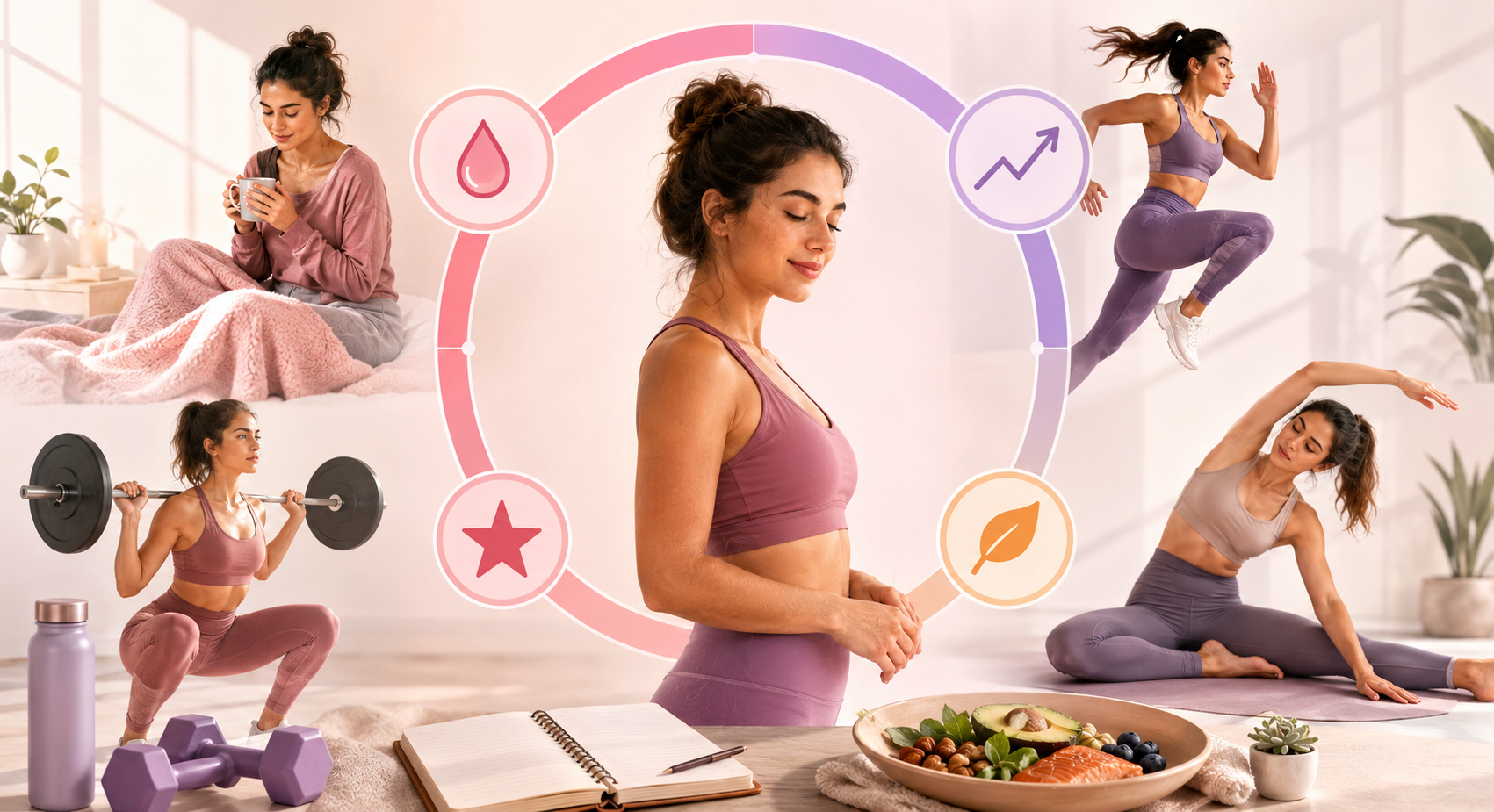
A typical cycle has four phases, each governed by a different hormonal cocktail. Understanding what's happening under the hood is the first step to working with your body instead of against it.
The injury risk nobody talks about
Here's something that surprised even me when I first learned it: Estrogen at its peak around ovulation makes ligaments more lax. ACL injuries in women are significantly more common mid-cycle for exactly this reason. This doesn't mean avoid exercise, it means be deliberate. Prioritise form, warm up properly and avoid reckless loading in that window even as you chase PRs.
What about nutrition?
Training by your cycle works best when your eating follows suit. In the follicular phase, your body handles carbohydrates beautifully, use them for fuel and performance. In the luteal phase, your carbohydrate tolerance drops and cravings rise (hello, progesterone). This is the time to lean into healthy fats, quality protein and magnesium-rich foods. Those cravings are your body asking for something real, give it that, not a punishing workout on top of it.
“Your body isn’t being difficult in the week before your period. It’s running a different programme entirely — and it needs different fuel.”
Why intensity timing matters
During the follicular and ovulatory phases, Estrogen is rising and peaking. This hormone does something remarkable: it improves insulin sensitivity, increases muscle protein synthesis and reduces perceived effort. In plain terms you recover faster, you get stronger results from the same work and it feels easier. This is not the time to go easy on yourself.
Then comes the luteal phase. Progesterone takes over, your core temperature rises slightly and your body starts preferring fat as a fuel source over carbohydrates. Your perceived exertion goes up the same run feels harder, not because you've got weaker, but because your physiology has genuinely shifted. Pushing through HIIT sessions here doesn't make you tougher. It raises cortisol, disrupts sleep and undermines recovery. Scaling back isn't laziness. It's intelligence.
| 11%
Greater strength gains when training aligns with cycle phases |
28
Days in the average cycle — your full training programme |
4x
More injury risk at ovulation due to ligament laxity from Estrogen |
How to start
You don't need to overhaul everything at once. Start by tracking your cycle for two months — just note your energy, mood and how your workouts feel each day. Patterns will emerge quickly. From there, begin shifting your most demanding sessions to days 6–16 and your recovery and moderate work to days 17–28. Let days 1–5 be genuinely restful.
Most of my clients report feeling less depleted, fewer mid-cycle slumps and this is the one that surprises them most, better results. Not because they are working harder, but because they are finally working smart.
Your cycle isn't a limitation. It's a 28-day roadmap your body has been handing you all along. It's time to start reading it.